



UTME’S WAKEUP CALL: THE NEED FOR STUDENT-CENTERED TEACHING IN NIGERIA
By Olanma (Solace) Okezie-Okafor, Sydani Institute for Research and Innovation
In 2025, the Joint Admissions and Matriculation Board (JAMB) released the results for the Unified Tertiary Matriculation Examination (UTME) in Nigeria and over 70% of nearly two million candidates scored below 200 out of 400.[1]
This concerning trend echoes a decade-long decline. In 2013, for instance, 1.5 million students also fell below 200, a pattern demanding scrutiny of root causes. [2] While many factors come into play in the appearance of this outcome such as quality of teaching received in secondary school institutions and facility related issues such as computer challenges at the point of examinations, Nigeria’s dominant teaching methods deserve priority analysis.
This UTME outcome signals a deeper educational issue across Nigeria. It serves as a wakeup call to the Nigerian government and the wider Nigerian society to prioritize reforms, starting with a shift to student-centered teaching methods. By empowering students as active learners rather than passive memorizers, this approach directly addresses poor exam performance and fosters lifelong skills.
Traditionally, within the Nigerian context, teaching methods and the educational testing structure push students to memorize or cram to pass exams. Strong memorizers invest time in rote learning, skipping deeper mental engagement. Weaker ones face academic setbacks and may doubt their intelligence. This can lead to disengagement, apathy, cheating, or poor retention.[3]
In both cases, these students aren’t taught in a manner that fosters learning outside their ability to memorize and so when faced with questions or situations that are not verbatim or near verbatim to what they were taught in class, they often panic and perform poorly.
The observation of poor teaching methods isn’t strictly reserved for secondary school. As these students progress into university, they are faced with more complex concepts under more strenuous conditions and end up struggling with feelings of anxiety and cycles of getting burnt out simply because they have been poorly equipped to learn.
Even in federal universities, lecturers often struggle to maintain consistent attendance or engagement, prompting high rates of self-teaching and cramming bulky handouts. All of this within a high-tension, fast-paced environment where failure means dropping out, delayed graduation, and financial burdens on families. Yet this system continues to reward those who can memorize and regurgitate, further cementing harmful habits across the educational pipeline.
If Nigeria’s future rests on its youth, then it is important to uphold every child’s right to not just access education, but access quality education. There is a need to reevaluate the systems in place within the educational sector, especially in federal and state learning institutions, as that is where most Nigerians can afford to receive education. Student-centered teaching emerges from research as a promising alternative, flipping the traditional script by placing students’ individual needs at the core rather than a one-size-fits-all approach
Student-centered teaching shifts the focus from the teacher as the sole ‘knowledge dispenser’ to students as active participants in their learning. Unlike teacher-centered methods which rely on lectures and uniform delivery, instructions are tailored to each learner’s background, strengths, and weaknesses. Teachers move beyond the one-size-fits-all traditional approaches. Instead, they incorporate modern methods like project-based learning (PBL) and interactive discussions, which can be incorporated into classrooms in conjunction with traditional teaching techniques. In PBL, students get the opportunity to tackle real problems, like community health projects, small-scale engineering or science projects, etc., which results in building application skills over cramming.
A valuable Nigerian study titled ”Effectiveness of Interactive Teaching Methods on Students’ Performance in Social Studies and Civic Education” (2025) provides concrete evidence. Researchers tested interactive, student-centered approaches against traditional methods in secondary schools. The results were striking: experimental groups using interactive methods improved dramatically—from 52.34 to 84.76 in Social Studies (a 32-point jump) and from 47.92 to 84.88 in Civic Education (nearly 37 points)—while control groups saw more modest gains, rising from 50.44 to 66.70 in Social Studies and 46.76 to 73.88 in Civic Education.[4]
These statistically significant improvements held steady across both urban and rural settings, proving these methods work even in resource-limited areas. These approaches teach students to think critically, directly addressing UTME’s comprehension gaps, and beyond UTME, equipping them to have a framework through which they can approach anything they will have to learn during their lives.
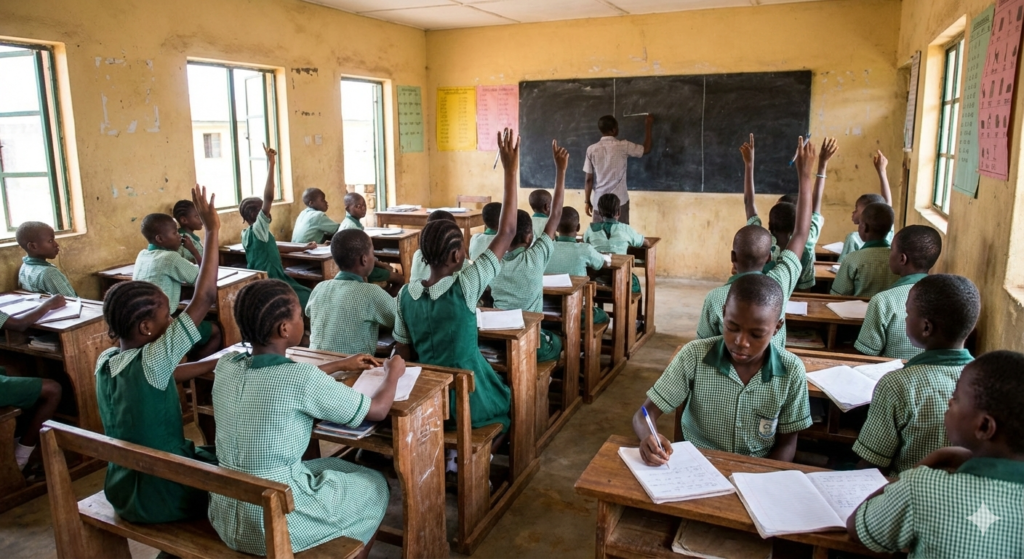
However, Nigeria faces significant challenges to implementing these student-centered teaching reforms. Overcrowded classrooms (often exceeding 60 students), [5] teachers untrained in modern pedagogical approaches, and funding shortages present formidable barriers. Yet low-cost initiatives—such as group discussions utilizing locally available materials—offer immediate starting points.
The following policy recommendations could address these obstacles:
National studies systematically comparing student-centered (or blended) methods against conventional teacher-centered approaches, assessing performance outcomes from secondary through tertiary education.
Nationwide teacher sensitization programs supported by dedicated funding, incorporating incentives to ensure broad participation.
Integration of student-centered reforms into NERDC curricula, commencing with pilot implementations in federal and state schools that serve most Nigerian students.
Nigeria’s future hinges on an education system that can equip youths to not just pass UTME, but to also drive national progress. Poor performance signals risks to workforce competitiveness, stifled innovation, and stalled development issues that demand urgent reform.
Policymakers, institutions, and educators must act decisively: prioritize student-centered teaching nationwide through funded pilots, teacher training, and curriculum reforms. Let us build learners who can think, solve, and lead.
REFERENCES
- Statistical Analysis of JAMB 2025 UTME Results. (2025). StudyPlace NG. https://studyplace.ng/jamb-2025-utme-results-analysis
- JAMB Releases Analysis of Total UTME Results from 2013 to 2025: Key Observations Spotted. (2025). Legit.ng. https://www.legit.ng/education/1624567-jamb-releases-analysis-total-utme-results-2013-2025-key-observations-spotted/
- Ezurike Chidubem Precious, Ayo-Vaughan Adewunmi Feyisetan. Influence of Teacher-Centered and Student-Centered Teaching Methods on the Academic Achievement of Post-Basic Students in Biology in Delta State, Nigeria. Teacher Education and Curriculum Studies. Vol. 5, No. 3, 2020, pp. 120-124. doi: 10.11648/j.tecs.20200503.21
- Effectiveness of Interactive Teaching Methods on Students’ Performance in Social Studies and Civic Education: An Experimental Study in Nigerian Secondary Schools. (2025). Journal of Research in Social Sciences and Language, 5(2), 45-62. https://www.journalijdr.com/impact-teaching-methods-academic-performance-secondary-school-students-nigeria
- SEAHI, S. E. A. H. I. G. P. (2023). Impacts Of Overcrowded Classroom on The Teachers’ Performance in Some Selected Public Junior Schools in Gashua, Bade Local Government Area of Yobe State, Nigeria. International Journal of Innovative Human Ecology & Nature Studies 11(4):50-57, Oct-Dec. 2023.