



Who Pays When the System Fails? How Health Financing Can Reinforce or Reduce Health Inequities
By Success David
Imagine two children falling ill on the same evening.
One lives in a household that can afford transport to a nearby clinic, pay for medicines, and absorb the loss of a day’s income. The other lives several kilometres from the nearest functioning health facility. Her mother has little money. Getting care may mean paying for transport, buying medicines and losing income she cannot afford to lose.
The illness may be the same. But the opportunity to respond to it is not.
This is at the heart of health equity. The World Health Organization defines health equity as the absence of unfair, avoidable or remediable differences in health between population groups. Where people live, how much they earn, and the resources available to them all shape their opportunity to achieve good health. [1]
Health financing sits quietly within this picture.
We often think about it simply: more financing should mean more resources, better services, and, ultimately, better health. There is truth in this. Health financing can influence access to services, the availability of medicines and health workers, quality of care and protection from the financial consequences of illness. [2]
But what if the relationship is not that simple?
What if the way a health system is financed helps determine not only how much care is available, but who is able to benefit from it, who carries the financial burden when care is unavailable, and which problems become more difficult to escape over time?
That question matters especially when we think about strengthening health systems. Financing is often treated as one component among many alongside health workers, medicines, infrastructure and governance. But financing also influences how these components interact. It affects where resources flow, who benefits, and how the system responds when pressures emerge.
In that sense, financing may be more than a resource flowing through the system. It may be part of the structure that influences how the system behaves.
Systems thinking offers a useful lens for understanding these relationships.
How do these inequities keep reproducing themselves?
Systems thinking suggests that health inequities are not always the result of a single barrier. They often emerge from interconnected feedback loops, where one disadvantage creates conditions that make another more likely.
For example, imagine the health system as three connected circles rather than three separate problems. One begins within households, another within the health system itself, and the third within the broader financing environment. Together, they help explain how inequities can persist over time.
Three connected loops that create persistent inequalities
1. When poor health deepens poverty
Consider the family in our opening example.
When money is limited, paying for transport, consultation, medicines, or lost working time becomes harder. This can lead to delayed or forgone care. If illness becomes more severe, treatment may cost more, and the caregiver may lose more income.
The household is now even less able to afford care the next time illness occurs.
Poverty → reduced ability to afford care → delayed care → worse health → higher costs and income loss → greater financial hardship → poverty.
This is a reinforcing loop: each part strengthens the next.
The scale of this problem is substantial. WHO estimates that 2.1 billion people experienced financial hardship from out-of-pocket health spending in 2022, while 1.6 billion people were pushed into, or further into, poverty by direct health-care costs. The burden is not evenly shared; poorer households are much more likely to experience financial hardship. [3]
The equity issue, therefore, is not simply that some people are poor and become sick. It is that illness can deepen the disadvantage they already face.
2. When weaknesses in the health system widen unequal access
Now follow the same family beyond the household and into the health facility.
What happens when financing is insufficient or unpredictable?
Facilities may struggle to maintain medicines and supplies, recruit or retain staff, maintain infrastructure or provide outreach services. These problems can reduce the availability and quality of care. [2]
Again, the effects are not necessarily equal.
A household with more resources may travel to another facility, pay privately, or buy medicines out of pocket. A poorer household may not have those options. It may wait, go without care or return only when the illness becomes more severe.
This creates another pathway:
Financing constraints → weaker service capacity → reduced access or quality → delayed or forgone care → poorer health → greater household financial burden.
The important equity question is therefore not only “Is a service available?” but “Who can still access care when the system is under pressure?”
3. When changes in external financing expose system vulnerability
External financing has played an important role in expanding and sustaining health programmes where domestic resources are limited. The challenge is not whether external funding is useful. It is what happens when financing changes.
When essential services are not sufficiently integrated into domestic financing, governance, and delivery systems, changes in external support can create gaps. Evidence from donor transitions shows that sustained coverage after external assistance is more likely when financing, governance, input management and service delivery are integrated into domestic systems. [4]
The potential cycle is:
Limited domestic financing → greater reliance on external support → externally financed programmes sustain essential services → funding changes → financing gaps or disruption → pressure to secure external support again.
This is not inevitable, and external financing does not automatically create dependence. But it raises an important sustainability question: have we built systems that can continue protecting people when the source of financing changes?
And again, equity matters.
When a programme is disrupted, people with more resources may find alternatives. Those with fewer options may simply lose access.
The three loops are connected. These are not three separate problems.
A financing disruption can weaken a service. A weaker service can delay care. Delayed care can worsen health. Worse health can increase household spending and reduce income. Greater financial hardship can make future healthcare harder to afford.
The loops feed into one another.
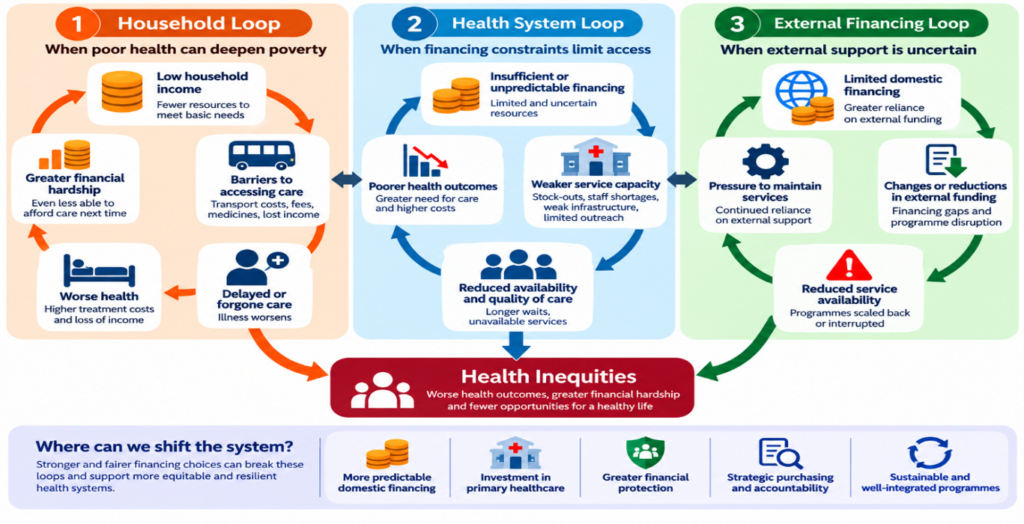
This is what makes health inequity difficult to address. The inequity we see today may be partly produced by processes that have been reinforcing one another for years.
What does this mean for health equity?
The implications go beyond whether a country spends more or less on health.
First, the same health system shock can affect people differently. A rise in transport costs, a medicine stock-out or the closure of an outreach service may be an inconvenience to one household and a reason to forgo care for another.
Second, equal financing does not automatically produce equitable access. A community with good roads, nearby providers and a stronger health workforce does not face the same barriers as a remote community with limited services. Financing decisions therefore affect who can realistically use the system.
Third, financial protection is part of health equity. In Nigeria, household out-of-pocket spending accounted for about 72% of current health expenditure in 2023. [5] When people must pay a large share of the cost when they become ill, access to healthcare can become closely tied to the ability to pay.
Finally, sustainability itself has an equity dimension. If essential services disappear when external support changes, the consequences may fall most heavily on people who have the fewest alternatives.
These are not only financing questions. They are questions about fairness.
Where can we change the system’s direction?
Seeing the loops changes the question we ask.
Instead of asking only, “How much more money do we need?”, we can ask, “Where can financing decisions change the way the system behaves?”
One starting point is domestic financing. The goal is not simply to raise more revenue, but to create a predictable foundation for essential services so access depends less on what a household can pay at the point of care. WHO identifies stronger prepayment and pooling, including government financing, as important to financial protection. [3]
But raising money is only the beginning. We also need to ask where it goes.
If people facing the greatest geographic and economic barriers are furthest from functioning services, directing resources towards primary healthcare may help change the access loop. WHO places equity at the centre of primary health care and emphasises bringing care as close as feasible to people’s everyday environments. [6]
Then there is financial protection. Reducing out-of-pocket spending can do more than make healthcare cheaper. It can help prevent illness from becoming a pathway into deeper poverty.
And money must translate into services. Stronger accountability is therefore essential. Are resources reaching the communities with the greatest barriers? Are facilities receiving funds on time? Are medicines and staff available? Are improvements reaching the people they were intended to reach?
Finally, we need to think about what remains when external funding ends. Sustainability requires more than keeping a programme running while a grant is active. Evidence from Africa points to the importance of local ownership, integration, adaptation, and sufficient financial and institutional capacity to sustain interventions. [7]
In other words, the goal is not simply to fill financing gaps. It is to build a financing system that can withstand them.
From financing more to financing for equity
Health financing is often discussed in terms of how much money is available and how large the funding gap remains. But this discussion becomes more meaningful when we ask what that financing does within the health system.
Does it protect households from financial hardship? Does it reach people facing the greatest barriers? Does it strengthen services where they are needed most? And can the system keep providing those services when funding sources change?
These are not only questions about financing. They are questions about health equity and the kind of health system we are building.
If we are serious about equity, the goal cannot simply be to put more money into the system. It must be to finance in ways that reduce disadvantage, protect those least able to absorb the costs of illness, and build systems that can keep serving them when circumstances change.
Because ultimately, the question is simple:
Who bears the cost when the system fails?
If that burden consistently falls on the households least able to afford it, then perhaps the challenge is not only to find more financing, but to rethink how we finance health in the first place.
References
- World Health Organization. Health equity [Internet]. Geneva: World Health Organization; 2026 [cited 2026 Sep 12]. Available from: https://www.who.int/health-topics/health-equity.
- World Health Organization. Health financing [Internet]. Geneva: World Health Organization; 2026 [cited 2026 Sep 12]. Available from: https://www.who.int/health-topics/health-financing.
- World Health Organization. Financial protection [Internet]. Geneva: World Health Organization; 2026 [cited 2026 Sep 12]. Available from: https://www.who.int/health-topics/financial-protection.
- Shroff ZC, Sparkes SP, Paina L, Skarphedinsdottir M, Gotsadze G, Zakumumpa H, et al. Managing transitions from external assistance: cross-national learning about sustaining effective coverage. Health Policy Plan. 2024;39(Suppl 1):i50-i64. doi:10.1093/heapol/czad101.
- World Health Organization Regional Office for Africa. Nigeria strengthens health financing capacity for universal coverage [Internet]. Brazzaville: WHO Regional Office for Africa; 2026 [cited 2026 Sep 12]. Available from: https://afro.who.int/countries/nigeria/news/nigeria-strengthens-health-financing-capacity-universal-coverage.
- World Health Organization. Primary health care [Internet]. Geneva: World Health Organization; 2025 [cited 2026 Sep 12]. Available from: https://www.who.int/news-room/fact-sheets/detail/primary-health-care.
- Nwaozuru U, Murphy P, Richard A, Obiezu-Umeh C, Shato T, Obionu I, et al. The sustainability of health interventions implemented in Africa: an updated systematic review on evidence and future research perspectives. Implement Sci Commun. 2025;6:39. doi:10.1186/s43058-025-00716-x.