



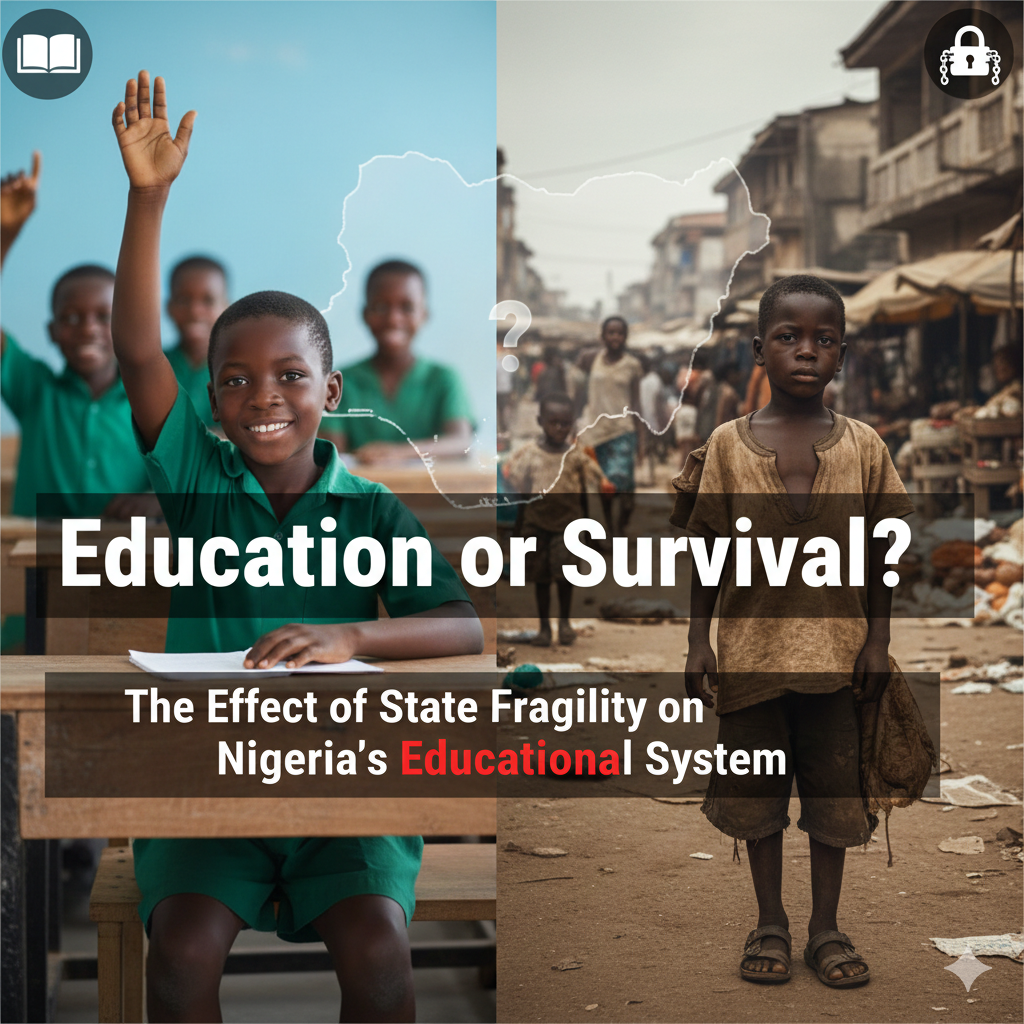
Education or Survival? The Effect of State Fragility on Nigeria’s Educational System
By Ifeyinwa Anosike, Sydani Institute for Research and Innovation
Introduction
Education is a key driver of individual development, human capital formation, and national socioeconomic progress. However, rising insecurity in Nigeria, characterized by terrorism, banditry, kidnappings, and persistent ethnic tensions, has increasingly disrupted the education system and weakened learning environments. Nigeria is classified by the International Monetary Fund as a fragile and conflict-affected state, a status associated with weak governance structures and heightened exposure to shocks that undermine citizens’ basic rights, including access to safe and quality education [1].
Current estimates show that 8.9 million primary school-aged children and about 8.8 million secondary school-aged children are out-of-school, with the conflict-affected Northeast and Northwest accounting for approximately 75% of these out-of-school children [2]. These figures demonstrate not only the scale of educational disruption but also the long-term consequences for human capital development, labour market readiness, and national productivity.
We will examine how state fragility shapes education outcomes in Nigeria, the implications for learners, teachers, and infrastructure, and the interventions needed to strengthen resilience within the education sector.
Fragility in Nigeria’s Educational System
Educational fragility is the reduced capacity of the education system to provide continuous, safe, and quality learning due to insecurity, weak governance, displacement, and resource disruption. The impact of this fragility on Nigeria’s educational system affects learners, teachers, infrastructure, and the nation.
Impact on Learners
The impact of this fragility on the educational system is felt by the learners. They include:
- Displacement and interrupted schooling: Insecurity forces learners to flee to IDP camps, causing family separation, loss of school records, and prolonged learning gaps. These disruptions lower motivation, widen skill deficits, and delay progression.
- Psychosocial distress: Exposure to violence and instability contributes to trauma and reduced concentration, which depresses attendance and performance.
- Foundational learning losses: Large shares of children struggle with basic literacy and numeracy, reflecting prolonged disruption and inadequate remediation. UNICEF reported that 73% of children aged 7-14 years cannot understand simple sentences and 75% cannot do simple mathematics problems, which the northern regions contribute to by over 70% of this rate [2].
Impact on Teachers
The impact on teachers in conflict and fragility settings includes:
- Attrition and absenteeism: Safety risks and poor working conditions lead to teacher withdrawals and frequent absences, leaving schools understaffed.
- Capacity gaps: Limited access to high-quality in-service training erodes subject matter knowledge and pedagogy, reducing instructional quality.
- Low morale: Stressful conditions, irregular pay, and weak support systems reduce professional commitment and classroom effectiveness.
Impact on Infrastructure
The impact on infrastructures can be seen in various ways, such as:
- School closures and damage: Conflict results in school shutdowns, classroom destruction, and facilities in disrepair, constraining access and safe learning spaces.
- Underutilization and waste: Repeated attacks and prolonged closures lead to abandoned or underused facilities and costly rehabilitation needs.
- Service disruptions: Loss of records, materials, and equipment hinders continuity of teaching and learning.
National-level consequences
- Human capital erosion: Cohorts leaving school without foundational skills depress future productivity and earnings.
- Higher fiscal burdens: Reconstruction, learning recovery, and social protection costs rise, crowding out other priorities.
- Lower growth and resilience: Skill shortages constrain labour markets, weaken competitiveness, and heighten the risk of intergenerational poverty.
Analysis of Impact
Educational fragility compounds over time. Disrupted learning in childhood translates into lower human capital in adulthood, such as reduced literacy, numeracy, and socio‑emotional skills, which dampens workforce readiness and innovation. Teacher attrition and poor instructional quality further entrench learning poverty, while damaged infrastructure curtails equitable access, especially for rural and conflict‑affected populations.
Collectively, these dynamics increase the likelihood of intergenerational poverty, as households with limited education face constrained earnings and fewer opportunities, making communities more vulnerable to future shocks. Addressing fragility, therefore requires coordinated measures that protect learning continuity (safety, psychosocial support, catch‑up programs), stabilize and upskill the teaching workforce, and restore/fortify infrastructure, alongside governance reforms that improve system resilience.
Measures to mitigate the impact of fragility on the education system
Several strategic interventions can help reduce both the short term and long-term impacts of fragility on Nigeria’s education system:
Strengthening Government Support for Affected Students
Reducing the impact of fragility on Nigeria’s education sector requires coordinated, targeted, and long-term policy actions. A critical first step is strengthening government support for students affected by insecurity.
Addressing these challenges demands a governmentled rapidresponse mechanism that ensures safe relocation to functional schools, continuity of instruction, and immediate psychosocial support. Such interventions directly mitigate fragility by restoring stability in learning pathways.
However, implementation remains challenging due to limited funding, inadequate coordination during crises, and the difficulty of providing safe transport and placement for displaced learners in already overstretched host communities.
Support and Capacity Building for Teachers
Teachers are central to sustaining learning in fragile contexts. Ensuring their safety, improving working conditions, and expanding access to professional development are essential for maintaining learning continuity.
Investing in teacher training, protection, and incentives improves both morale and content delivery, while stabilizing the human resource base of the sector. These interventions address fragility by enhancing system resilience and ensuring that learning continues even under adverse conditions.
Nonetheless, challenges such as insufficient funding for teacher training, weak monitoring systems, and persistent security threats complicate implementation.
Implementation of National Education Reforms
The Nigeria Education Sector Renewal Initiative (NESRI), recently introduced by the Federal Ministry of Education, represents the most comprehensive government reform effort aimed at transforming the education system. Its pillars, ranging from curriculum reform and digital learning expansion to technical and vocational training, infrastructure improvement, reintegration of out-of-school children, and support for girls’ education, touch directly on structural weaknesses aggravated by fragility.
If effectively implemented, NESRI could help rebuild damaged infrastructure, modernize learning delivery, and strengthen governance mechanisms that make the system more resilient to conflict-related disruptions [3].
However, NESRI’s success will depend on sustained political will, transparent financing, strong state-level adoption, and the ability to operate effectively in high-risk or hard-to-reach areas. Without these conditions, NESRI risks becoming another policy document with limited practical impact.
Conclusion
Nigeria’s education system continues to face severe pressures from insecurity, displacement, weak infrastructure, and declining teacher capacity, which are challenges that collectively reinforce educational fragility and hinder learning continuity. In considering the effects of fragility on Nigeria’s educational system, we have seen how it disrupts foundational learning, teacher attrition and inadequate training lower instructional quality. Strengthening government responsiveness, improving teacher support systems, and implementing large-scale reform efforts such as the Nigeria Education Sector Renewal Initiative (NESRI) are measures that will help mitigate these effects.
Looking ahead, Nigeria’s ability to mitigate educational fragility will depend on sustained policy commitment, adequate financing, and continuous protection of learners and teachers in vulnerable regions. By prioritizing security, investing in resilient school infrastructure, and scaling reforms that rebuild trust in the education system, Nigeria can strengthen learning continuity and safeguard the future of its youth. A stable and inclusive education system is not only critical for national development, but also essential to ensuring that no child is forced to choose between education and survival.
References
- Oseghale, C. O. (2024). The Impact of Climate Change on Nigeria’s Fragile State. International Journal of Novel Research and Development (IJNRD), 9(3) b136.
- UNICEF (2023). Nigeria Education Fact Sheet. Available at Nigeria factsheet 2023 [Accessed on 28/01/2026]
- Guardian Nigeria (2025). FG outlines reforms to improve quality of education. Available at https://guardian.ng/education/fg-outlines-reforms-to-improve-quality-of-education/